
The Great Fire of 1813: How San Sebastian rose from the ashes
What happened in the fire of 1813
In 1808, San Sebastian was invaded by the French army during the Napoleonic Wars. The soldiers stationed here spent five years living alongside the people of San Sebastian, who, whilst not particularly pleased with their presence, tolerated it as best they could for the greater good.
Then, in 1813, Anglo-Portuguese soldiers led by the Duke of Wellington arrived in Donostia; like Napoleon, he never set foot here, but his influence was felt throughout the region. The Anglo-Portuguese troops had orders to take the city by any means necessary. And indeed, that is exactly what they did.

The Anglo-Portuguese troops entered the city through the breach in the city walls.
On the morning of 31 August, after blasting a huge gap in the city walls with cannon fire, the English and Portuguese entered San Sebastian. Exhausted, frustrated and furious after months of fighting and the loss of comrades, they quickly found alcohol in the houses, which triggered a spate of war crimes including the murder of civilians, rape and looting, culminating in the great fire that razed the entire city to the ground, sparing only a single street, now known as ‘31 de agosto’ (31st of August).
The reconstruction of San Sebastian
Just one week after the fire, the survivors from Donostia gathered in Zubieta, a suburb on the outskirts of the city, where many had fled to escape the damage. There, they decided that the city should be rebuilt, not abandoned, and that Donostia would be restored to its former glory.
The rationalist layout of the town centre
To rebuild the city, a new urban planning project was commissioned to architect and engineer Pedro de Ugartemendia, who presented a vision for a city that was completely different from the Donostia that had been destroyed by fire. He devised an innovative plan, in which the centre consisted of an octagonal square with streets radiating out in a star-like pattern towards the city’s most important landmarks, such as the churches of Santa María and San Vicente, the harbour and the main gate in the city walls. The remaining streets ran at right angles to one another, creating a grid-like pattern that completely transformed the previous layout.
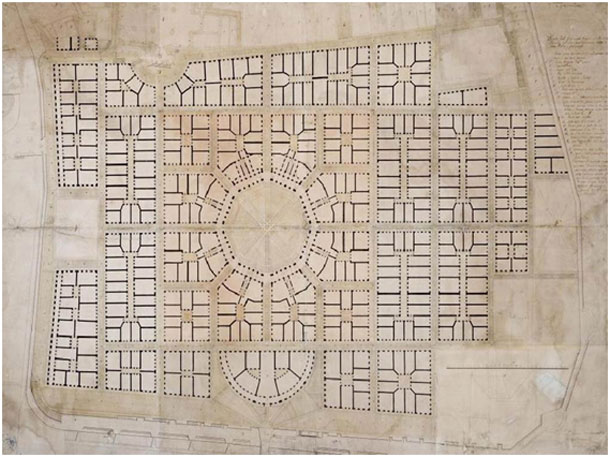
Ugartemendia’s project.
This highly innovative idea, however, had a great many opponents, particularly amongst the landowners, who saw their properties being altered in a way that caused them to lose land and money; as a result, the project was rejected. As a reminder of that project, today, next to the kiosk on the Boulevard, the ground is marked out to show the layout of the square that never came to be.
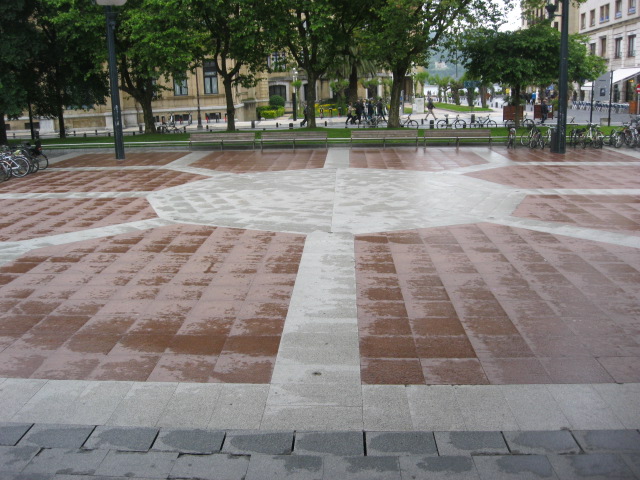
A memento of the square that never was. Photo from El Diario Vasco.
Other proposals were put forward in the years that followed, also with a strong rationalist character, before one was finally adopted that barely affected the old streets, respecting the existing plots and making only minor alterations to a few streets. We can therefore say that the current Old Town is almost identical to the pre-fire Donosti.
The new architecture
Even so, there were changes: the houses, which had previously been built mainly of wood and brick – apart from the foundations – were rebuilt in stone, although the wooden beams were retained. Some streets were widened to allow for better air circulation and to let more light reach the lower floors. Most importantly, a comprehensive plumbing and sewerage system began to be installed so that water could be supplied to the houses and drained away from them.
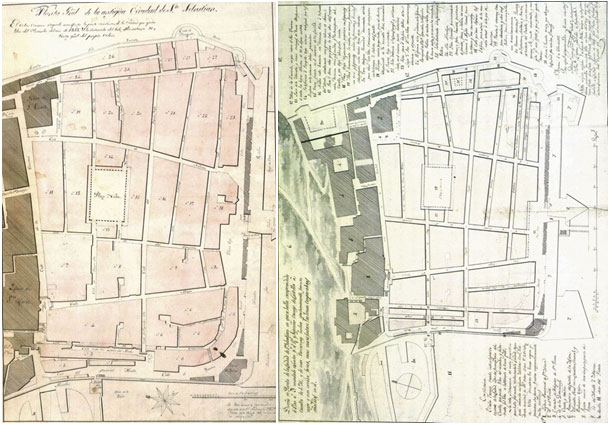
A comparison of Donostia before and after the reconstruction. As you can see, the changes are minimal.
Consequently, the living conditions of the people of San Sebastian were also transformed; houses were improved, making them more comfortable and spacious, and, overall, San Sebastian became a more modern and cleaner city.
Places that still bear traces of the fire
Although the Old Town we see today is new – being less than two hundred years old – there are parts of the neighbourhood that still bear traces of the fire or transport us back to that medieval city. On 31st of August Street, for example, there are still some houses dating from before 1813, where you can see the use of brick and timber in their structure.
Santa Korda Street is another example of old Donostia, as it is the only street that retains its original medieval layout, hence its darkness and narrowness.
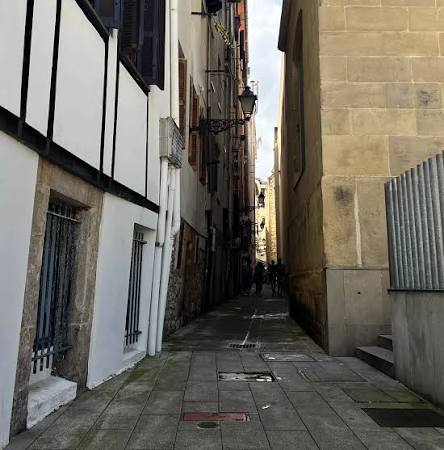
Santa Korda Street as seen from Zuloaga Square. Photo by Basque Bites.
Not far away, in the church of San Vicente, the scorch marks on its walls and the bullet holes left by the Anglo-Portuguese soldiers when they entered Donosti can still be seen today. Where the marks of the looting are not visible, but the void it left behind is, is in the Basilica of Santa María, formerly lavishly decorated with gold and silver; today its walls are bare, victims of the theft committed by those soldiers who, although they came to help, brought nothing but misfortune.

A lifelong San Sebastián local, Art Historian, and tour guide with years of experience in the region. Her passion for art, languages, and travel shows through in content that blends cultural depth with local insight, helping readers discover San Sebastián through the eyes of an expert.