
The Battle of Oriamendi: History, tour and legacy in San Sebastian
What was the Battle of Oriamendi?
The Battle of Oriamendi took place in San Sebastian on 16 March 1837, during the First Carlist War.
Historical context
During the 19th century, Spain was plagued by various conflicts over the succession, which led to a series of civil wars known as the Carlist Wars; there were three such wars, spread across different decades. The first, which took place between 1833 and 1840 and was, naturally, known as the First Carlist War, began with the appointment of Isabella, daughter of the then King Ferdinand VII, as heir to the throne, whereas until her birth the king’s brother, Carlos María Isidro de Borbón, had held that position.
Under the laws of succession at the time, women could not become queens, but Ferdinand VII abolished these laws to allow his daughter to ascend the throne, in accordance with earlier legislation which permitted a woman to become queen provided she had no brothers – which was indeed the case with Isabel.
Carlos, who called himself Carlos V, refused to accept this appointment, denouncing it as despotic and illegal, and thus sparked a war that would last seven years. At the end of the conflict, the Isabelinos emerged victorious, and Isabella was proclaimed Queen of Spain until her death in 1868, which led to the Second Carlist War.
Key figures and opposing factions
This war pitted two factions against one another, known as the Isabelists and the Carlists.
The former supported the future Isabella II in her claim to the throne; the latter supported Carlos María Isidro de Borbón, Isabella’s uncle.
In the Basque Country, the two factions became particularly significant, with Isabella being supported by the cities, which tended to be more liberal, and Carlos by the rural areas, which were generally more conservative.
In addition to the Spanish combatants, English troops fighting on Isabella’s side took part in this war, having arrived from the United Kingdom at the request of Isabella’s mother, the Queen Regent María Cristina de Borbón.
How the battle unfolded
Dates, locations and tactics
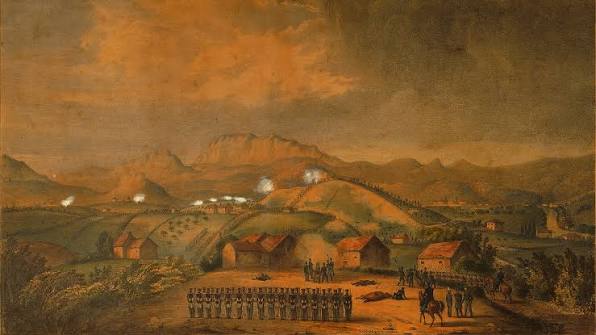
The battle began on 10 March, with the British occupying Lezo and Ametzagaña. Realising the weakness of the Carlist troops, the soldiers rested on the 11th, before attacking Loyola on the 12th and capturing it the following day. On the 14th, they marched on Aiete and Oriamendi, occupying them the following day.
At the same time, Carlist reinforcements arrived from Pamplona, passing through Tolosa on the 15th and reaching Hernani at dawn, on the other side of Oriamendi, thus commencing the battle. After fierce fighting, the Carlists prevailed over the Isabelinos, who fled to San Sebastian, a Liberal city, in a disorderly and chaotic manner, leaving many casualties behind them and a large number of soldiers wounded and/or captured.
Consequences for Donostia
Although Donostia itself was not directly affected by the events of this battle – as Mount Oriamendi lies on the outskirts of the city, on the border with Hernani – the fact that the British troops suffered such a catastrophic defeat even reached the British Parliament, where it was regarded as a humiliation and a disgrace for the army.
Visiting Mount Oriamendi today
What to see at the site of the battle
Today, at the site of the battle, there are barely any remains of an old fortification from the First Carlist War, situated on the site of an earlier chapel that no longer exists. Vegetation has almost completely overgrown the area, so if we go there, we will see nothing but trees and a meadow. Even so, although it is not a very high hill (195 metres), it offers superb views of San Sebastian, the Urumea Valley and the Oria Valley – which is why the aforementioned fortification was built there in the 19th century – and makes for a pleasant place to walk.
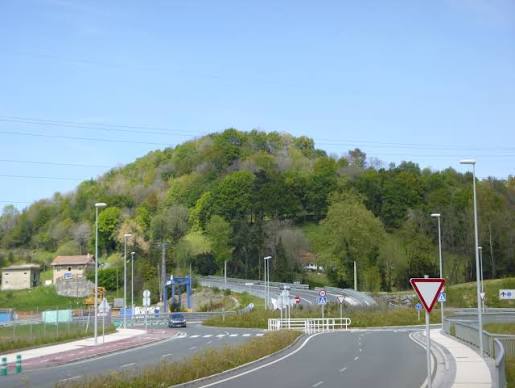
Mount Oriamendi from Hernani. Photo from Wikipedia.
Recommended walking or cycling route
The cycle path now extends all the way here, and you can reach both Hernani and Lasarte by following it. If you’re keen to enjoy some great views and are interested in history, it might be a good idea to cycle here on an e-bike, passing through the very same neighbourhoods that the English once did.
You can also walk here: starting from Aiete and passing through Miramón Forest, you’ll soon reach Oriamendi, whilst enjoying the natural surroundings and the views of the area.
Interesting facts and the legacy of Basque culture
After the battle, the Carlists found the sheet music for an English song amongst the items left behind by the British; they adapted the melody and lyrics to create the well-known Carlist anthem ‘Oriamendi’.
Some of the English soldiers and officers who fell in the Battle of Oriamendi are now buried on Mount Urgull, in the English Cemetery. It is said that they are buried here because, as Protestants, they could not be buried in Polloe Cemetery; furthermore, the northern slope of Mount Urgull is said to be the part of the city closest to England, meaning the soldiers would be as close to home as possible.

A lifelong San Sebastián local, Art Historian, and tour guide with years of experience in the region. Her passion for art, languages, and travel shows through in content that blends cultural depth with local insight, helping readers discover San Sebastián through the eyes of an expert.