
The Siege of San Sebastian in 1813: History, consequences and places to visit today
Historical context
In 1808, Napoleon’s troops arrived in San Sebastian after Ferdinand VII had invited Napoleon to march through Spain to attack Portugal, an ally of England, France’s greatest enemy. As we know today, attacking Portugal was merely the excuse used by Napoleon to enter and invade Spain, installing his brother, the future José I, as king. Thus, the French army established itself in Donosti, amongst other cities, for five years until they were expelled at the end of the War of Independence in 1814.
The War of Independence began with the uprising of 2 May 1808 in Madrid and quickly spread throughout the peninsula. In addition to the Spanish and French, the conflict also involved the English and Portuguese, the principal enemies, as we have already mentioned, of France; and the Poles and Italians, allies of France.
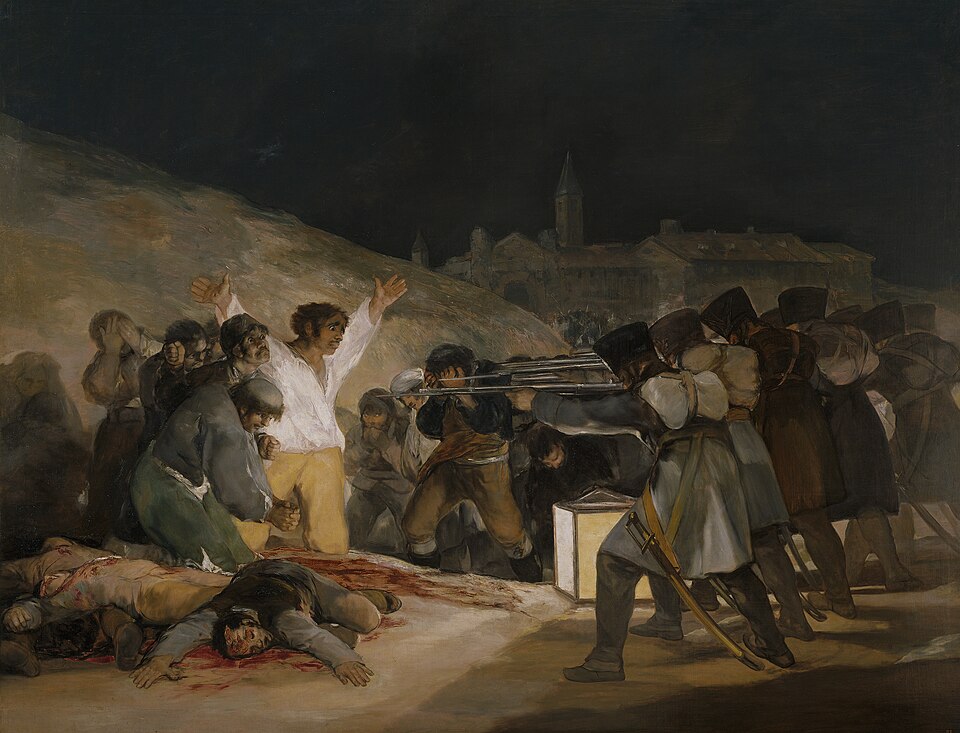
Francisco de Goya’s The Third of May 1808 depicts the very day after the uprising in Madrid and is one of his best-known paintings.
In San Sebastian, the war had little impact during the early years, and the French presence was more or less well accepted by the population, a mix of Basques and Gascons with deep-rooted French influences and strong liberal ideals. With the arrival of the French, local people with pro-French views were placed in positions of power, so the transition was, on the whole, fairly smooth, and coexistence with the French soldiers proceeded without major complications. However, this situation would change radically with the siege of San Sebastián in 1813.
What exactly was the siege?
Dates, key figures, sides
The siege of San Sebastian took place between 7 July and 8 September 1813. Those under siege were the citizens of San Sebastian and the French soldiers stationed in the city under the command of Louis Emmanuel Rey. The besiegers, on the other hand, were the British and Portuguese forces led by Thomas Graham, who was acting on the orders of the Duke of Wellington, who never actually set foot in the city.
Course of events
The siege of San Sebastián can be divided into two distinct phases. The first was not particularly successful, as the English and Portuguese soldiers were positioned on the other side of the River Urumea, in what is now the Gros district, meaning that the city could continue to receive supplies and food by sea and land from the north and west. During the early days of this first siege, the Anglo-Portuguese troops attempted to damage the city walls with cannon fire, creating several breaches and placing a mine in one of them, in the hope of capturing the city on 25 July.
This first attack was a failure, as the mine exploded too early; it was still dark and visibility was poor, leaving the vanguard soldiers isolated as they could not receive support and exposed across a 300-meter-wide stretch. Almost 700 soldiers are killed or wounded, and more than 300 are taken prisoner. In comparison, only 58 French soldiers are killed and fewer than 300 are wounded. Following this, the Anglo-Portuguese forces decide to wait to launch a new siege until fresh supplies arrive.
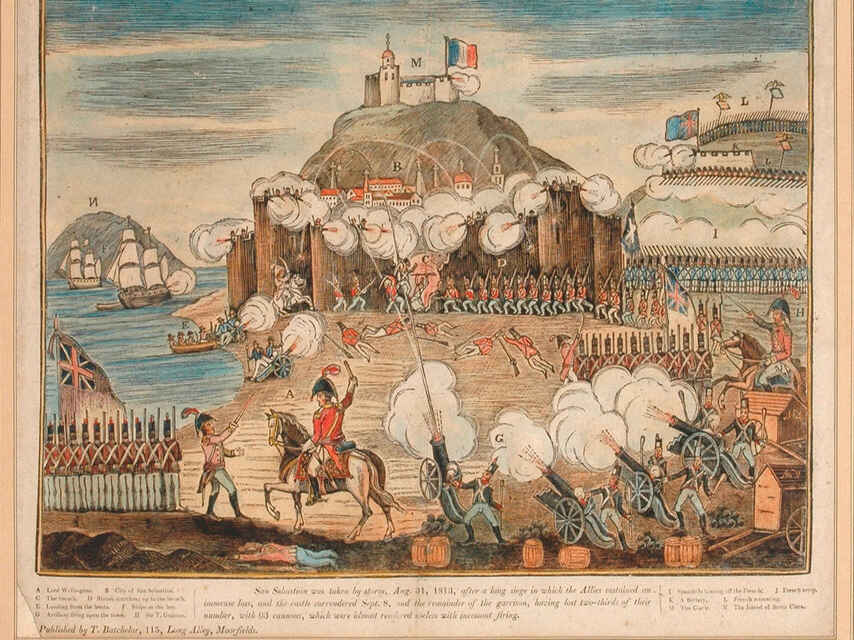
Engraving of the siege of San Sebastian in 1813.
The second siege began in mid-August, when these supplies, accompanied by engineers, arrived in San Sebastian. The English first captured the island of Santa Clara, thereby cutting off the supply line and surrounding the city. Many residents of San Sebastian fled during these days towards Zubieta via La Concha, hoping to avoid the almost certain bloodshed.
Thus, on the morning of 31 August, the Anglo-Portuguese troops launched a second attack, taking advantage of the low tide; using a new mine, they opened a new breach in the wall, only to discover that the French had built an inner defensive wall. The attacks on the eastern wall were also repelled, suggesting that this second assault was going to be another failure.
It was then that the English decided to fire a cannonball at this new inner wall, risking the lives of their own soldiers—which, at first glance, seemed madness. The plan goes ahead; they destroy the inner wall, and the English and Portuguese soldiers are finally able to enter the city, spreading out through the streets. Seeing that the situation is slipping from their grasp, the French flee to La Mota Castle atop Mount Urgull, where they entrench themselves, leaving the people of San Sebastian who are still in their homes to their fate. By midday, San Sebastian has been taken. This moment marked the definitive end of the siege of San Sebastián.
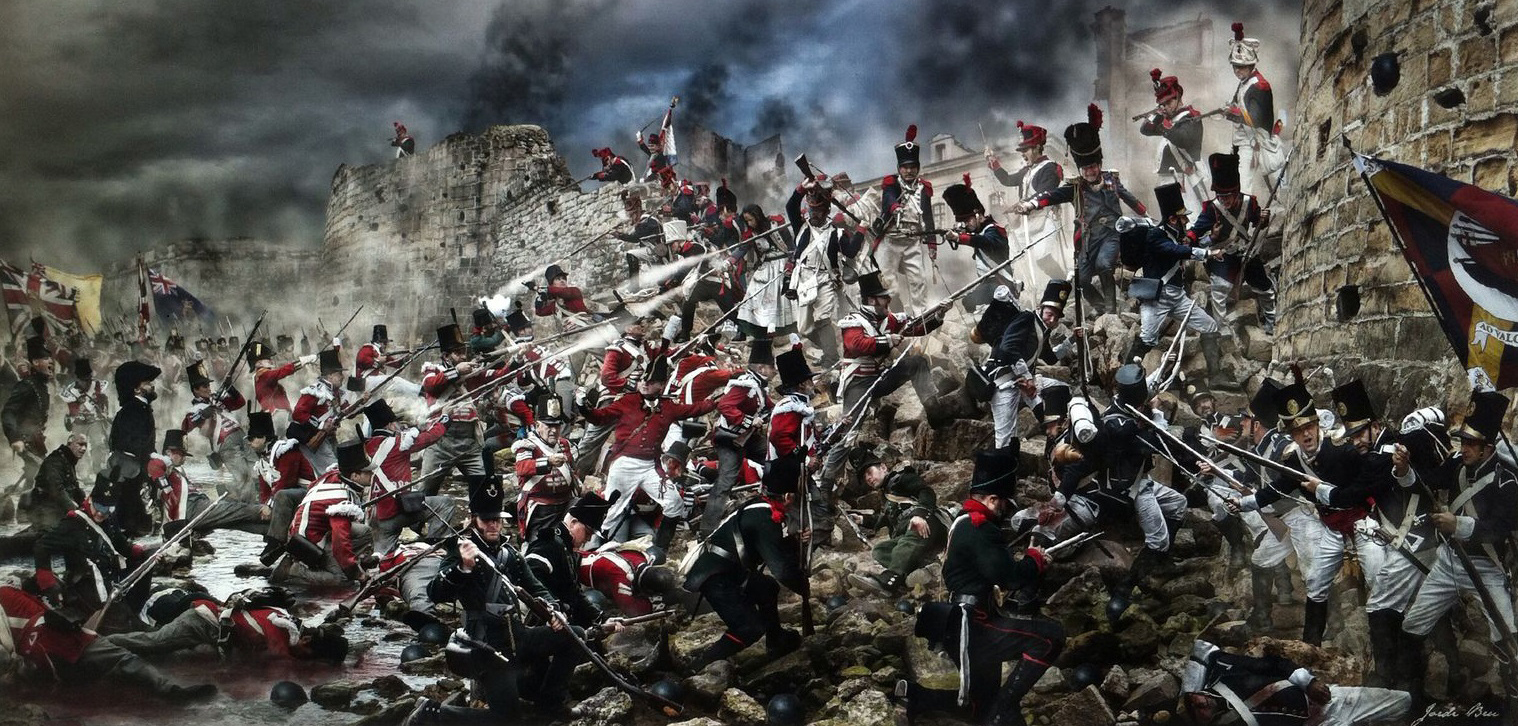
Photographic reconstruction of the storming of the city walls by Jordi Bru.
Consequences for the city
When the English and Portuguese soldiers finally entered San Sebastián, they discovered wine and brandy in the shops and houses, got drunk, and lost all sense of reason. They set about looting, murdering the locals they came across, raping women and then killing them, and eventually setting fire to the houses. It is estimated that half the population was massacred, and only a few buildings survived. It is, without a doubt, the greatest tragedy ever to have befallen the city, the scars of which we can still see today and which we continue to remember more than 200 years later. The consequences of the siege of San Sebastián forever transformed the city’s history and urban layout. And with our private tour or our military history tour, led by Go Local, you can discover this part of San Sebastián’s history.
Places in San Sebastian related to the siege (memorials, neighbourhoods, architecture)
At the time of the siege, San Sebastian consisted solely of the neighborhood we now call the Old Town, which is why all the sites associated with it are concentrated here. The main site is 31 of August Street, so named because it was the only street to survive the attack, and even then only half of its houses did so – those closest to Mount Urgull.
Other surviving buildings are those built of stone that did not burn down: the church of San Vicente (where you can see the scorch marks and bullet holes), the Basilica of Santa María del Coro (whose interior, entirely covered in silver and gold, was looted until nothing remained), the Convent of San Telmo (used as barracks by the French) and the Castle of La Mota, all of which are, therefore, the oldest buildings in the city. There are also remains of the city walls, those visible in the port and those located underground, which can be seen once you descend to the Boulevard car park. All of these sites provide a better understanding of the impact of the siege of San Sebastián on the local population.
There are, of course, various monuments commemorating the events of that tragic 31 August 1813 and the days that followed. All are located on the street of the same name. Starting with the church of San Vicente, in the alleyway of Valle de Lersundi we find a sculpture of a woman carrying stones or bricks in a basket on her head. She is the rebuilder and represents the entire civilian population, mainly women, who helped rebuild the city once all the soldiers, from both sides, had left Donosti.
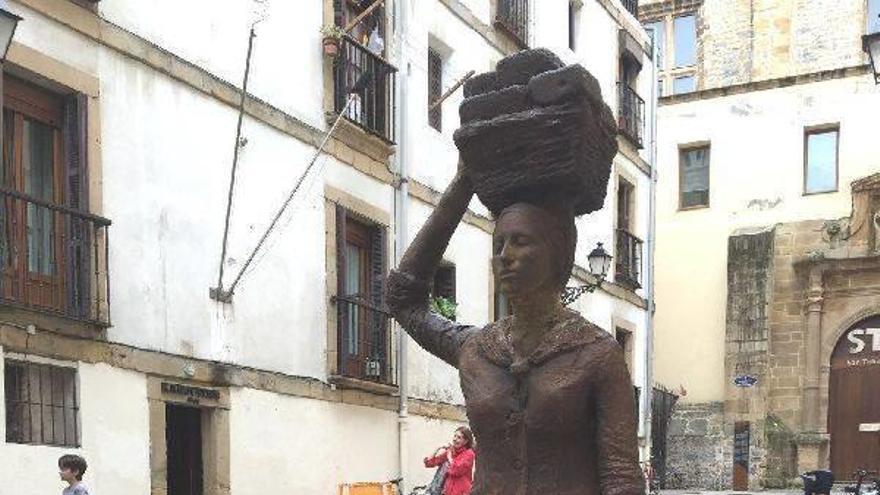
Dora Salazar’s Rebuilder. Photo by Noticias de Gipuzkoa.
A little further on, opposite San Jerónimo Street, there are commemorative plaques on the façade of the house explaining that the survivors gathered there following the meetings in Zubieta, where it was decided that San Sebastian had to be rebuilt.
Finally, just a few meters away, a red relief plaque on the façade of the oldest house in the Old Town commemorates all the victims from San Sebastian of the looting and burning carried out by the Anglo-Portuguese troops.
How to visit today—suggested historical routes
To learn more about this event, we recommend you join one of our Free Walking Tours, of course, where we’ll tell you everything you need to know about what happened and lots more about San Sebastian, its history, and its culture. During the tour, you’ll discover the main sites of the siege of San Sebastián and its consequences.
But if you prefer to explore on your own, we recommend you start your tour at La Bretxa, head down to the car park and admire the remains of the city walls. Then continue straight along San Juan Street to the church of San Vicente and turn left there onto 31 of August Street. Once in Santa María, head up to Urgull Castle. From the top, you can admire our city and appreciate the reconstruction work we’ve carried out in just thirty-five years.
Interesting facts and myths
To this day, it is still not known in which house the fire started or who started it, but according to contemporary accounts, it seems quite clear that it was the English. This remains one of the major historical debates surrounding the siege of San Sebastián.
When the decision was made to rebuild the city, the municipal architect devised a new layout for Donosti, with an octagonal square at the center and streets radiating out from it like a star. This project was never carried out because the landowners did not want to lose any of their land or have their plots altered.
Our most important day, Saint Sebastian’s Day, has its origins in the French invasion. That is why the uniforms of the drumming troupes may be those of Napoleonic soldiers but also of English or Portuguese soldiers.
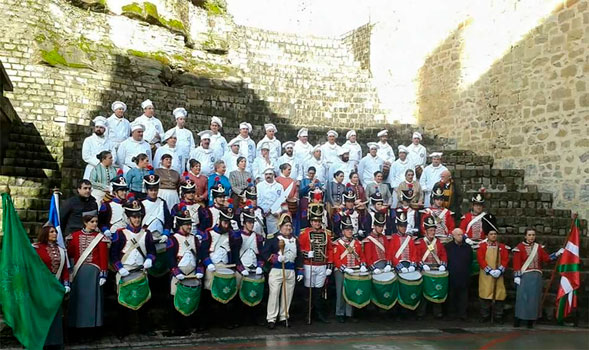
In the drum company (tamborrada) organised by the Cofradía de Gastronomía, the drummers are dressed as Englishmen and Frenchmen.

A lifelong San Sebastián local, Art Historian, and tour guide with years of experience in the region. Her passion for art, languages, and travel shows through in content that blends cultural depth with local insight, helping readers discover San Sebastián through the eyes of an expert.