
The Mater: The story of the last Basque tuna boat and how to visit it
History of the Mater tuna vessel
The history of the Mater dates back to 1990, when the Etxegoien family from Getaria, who had always been fishermen, decided to build a new fishing boat. So, in Asturias, more specifically in San Esteban de Pravia, they had the hull built, entirely from wood, and the rest of the assembly was carried out in Zumaia, very close to Getaria.
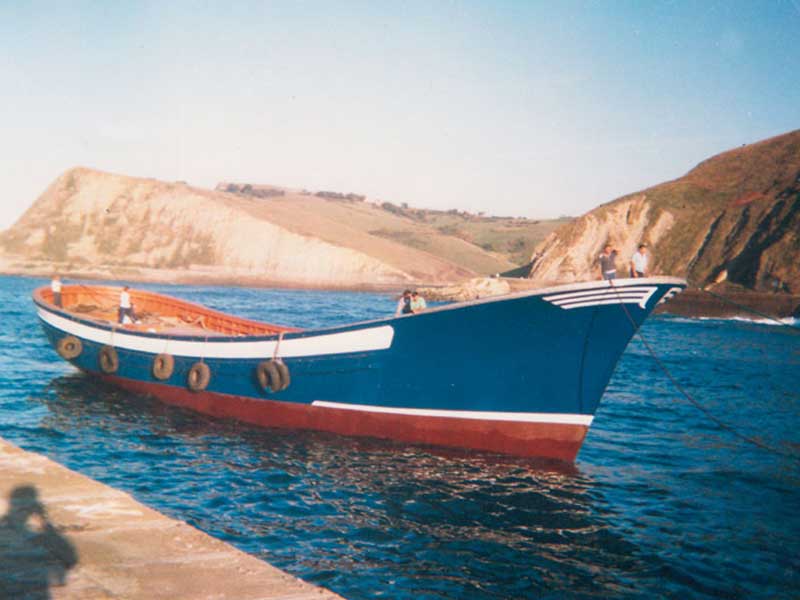
The hull of the Mater on its arrival in Zumaia. Photo by the museum.
Thus, although it was not built entirely in the Basque Country, the Mater was indeed the last wooden tuna boat operating off our coast, making it a unique remnant of traditional Basque vessels.
As well as fishing for albacore, mackerel, sardines, and anchovies across much of the Atlantic, the Mater also took part in the cleanup operation following the Prestige oil spill in 2003, alongside dozens of other vessels. Finally, after 13 years of hard work, the Mater was retired and was on the verge of being scrapped, and it was at this point that the Itsas Gela – Aula del Mar association decided to rescue it and give it a new lease of life as an eco-active museum ship.
Its role in traditional Basque fishing
The Mater is a tuna boat, or a bonito vessel, primarily used for fishing albacore or longfin tuna in the waters of the Cantabrian Sea. Like any traditional bonito vessel, on the Mater, each tuna was caught using rods and live bait, usually anchovies caught earlier. Along with a sprinkler system designed to trick the tuna into believing the boat was actually a huge school of anchovies, the working days stretched on for hours, as each tuna had to be caught one by one.
However, the voyages did not last too long, as fishing usually took place in the Cantabrian Sea, as we have already mentioned, although on some occasions the Mater did fish near Africa.
How it was restored and refurbished
The Itsas Gela – Aula del Mar association was founded in 2001 and, just two years later, salvaged the Mater to convert it into a museum ship. As well as restoring it, the ship was adapted to its new purpose, with some now-unnecessary parts removed and others added, so that the former tuna boat could be transformed into the museum it is today.
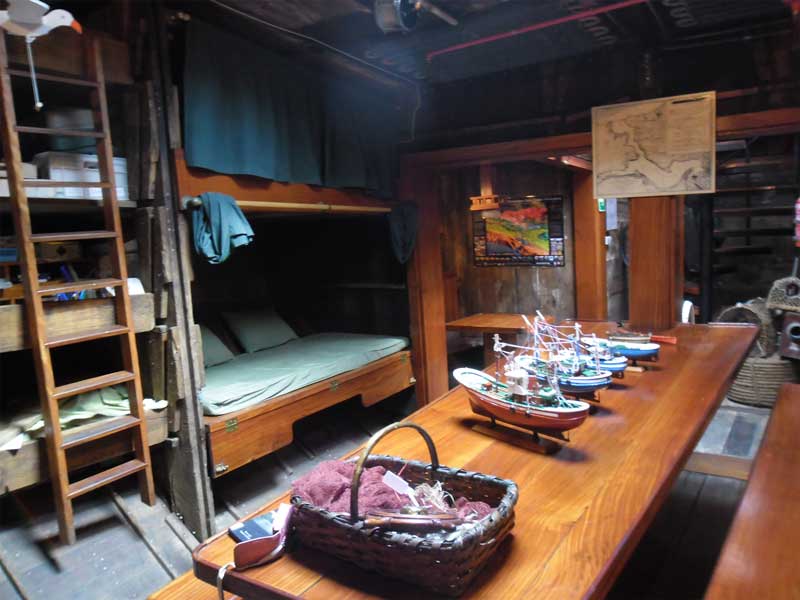
A former hold, now converted into a multi-purpose room. Photo by the museum.
One of the main changes was the removal of the huge hold used to store the fish until the ship reached port for sale. In its place, a large multipurpose room was built, featuring a long table for meetings, snacks, and training sessions, as well as bunk beds to accommodate groups wishing to enjoy the unique experience of sleeping on a ship.
The rest of the Mater remains almost intact; in fact, the original cabins for the crew, engineers and officers, the galley, the bathrooms, the bridge and the engine room have all been preserved. All of these can be visited when touring the museum ship.
How to visit it today
Location of the ship
The boat is moored at Pasajes San Pedro at the far end of the harbour, very close to the ferry that crosses to San Juan and just before the Albaola maritime museum. It is therefore very easy to get there on foot, by car or by bus, and also by boat, of course, if you’re coming from Pasajes San Juan.
Activities, guided tours and workshops
As we’ve already mentioned, the boat is open to visitors. Through guided tours, you can learn how albacore tuna was caught, about the different parts of the boat, and what life was like for a sailor on board. But the Mater also organizes tours of San Pedro and San Juan, the fish market, and the port, as well as workshops on ecology and waste collection… And, as any proper boat should, it also organizes trips out to sea, whether to enjoy the coastal cliffs, spot whales and dolphins, or, of course, to go fishing. It’s best to check their calendar to keep up to date with all these activities, which vary depending on the time of year.
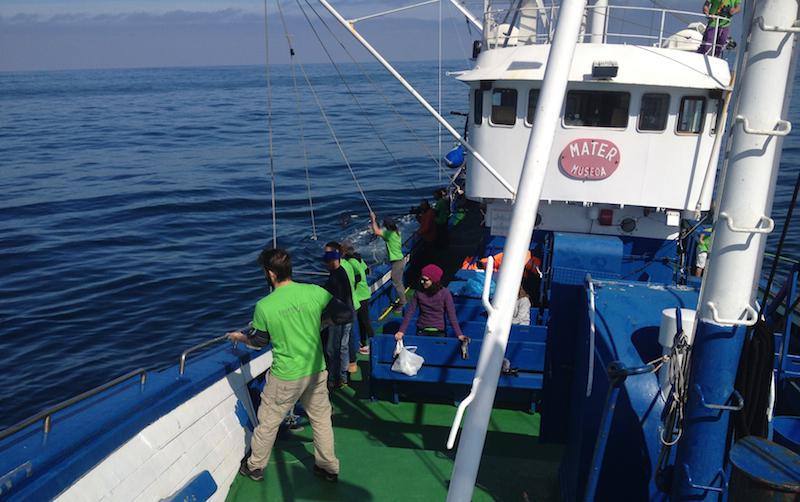
Waste “fishing” on board the Mater. Photo by Oarsoaldeako hitza.
The Mater and Basque maritime culture
As we have already mentioned, the Mater is a traditional tuna boat on which typical fishing techniques were used, techniques that are still employed on more modern vessels today. As such, the Mater is a unique place, as it allows us to discover this aspect of Basque maritime culture, which is normally out of reach for most people, in a way that is accessible, educational, and fun. It is a perfect way to teach children where their food comes from and about traditional fishing techniques, bringing them closer to an essential part of our culture.

A lifelong San Sebastián local, Art Historian, and tour guide with years of experience in the region. Her passion for art, languages, and travel shows through in content that blends cultural depth with local insight, helping readers discover San Sebastián through the eyes of an expert.